Isobel (Iso) Rae
1860 - 1940
Biography
Isobel 'Iso' Rae undertook studies at the National Gallery School, under the tutelage of George Folingsby (Painting) and Oswald Rose Campbell (Design), consistently receiving honours for her work. She exhibited with the Victorian Academy of Arts from 1881 -83 before moving to France with her mother and sister in 1887. Here she attended the Academie Colarossi and by the early 1890s the family settled in Etaples, a picturesque fishing village on the coast of northern France, home to a vibrant expatriate arts community, where she crossed paths with fellow NGV students Rupert Bunny and James Quinn.
Rae continued on occasion, to show her work in Australia and gained recognition with inclusions of her work in the Old Salon, Paris and Royal Society of British Artists, London. Her work shows the influence of impressionist and post-impressionist concerns encountered in Paris at this time. Rae’s paintings en plein air, focussed not only on landscape but to the people of the area. In 1892, the Society of Friends of the Arts of Etaples was established, a group with which Rae exhibited.
In 2020, the NGV announced the acquisition of Rae’s Young Girl, Etaples c.1892, purchased for $220,000, a record for her work.
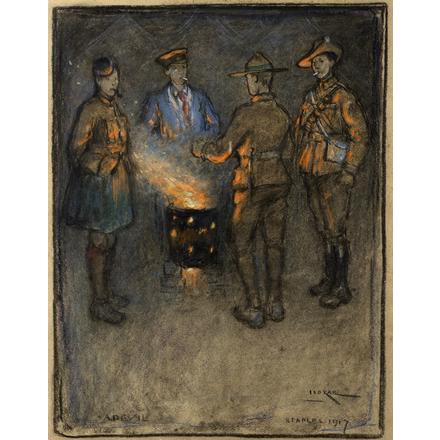
Iso Rae was a skilled draughtsperson, her marks lively and capturing a spontaneity, yet balanced with thought-out and balanced compositions. She produced around 200 drawings, mostly pastels and gouache, depicting the daily life of the military camp at Etaples, with its soldiers in their various uniforms; the barracks; the hospitals; the prisoners, both German and allied; their accommodation; the horses; their training and recreation (football, cinema, theatre).
Despite the official appointment of nearly twenty Australian male war artists, Rae was one of only two Australian women who documented the war for many years (the other artist was Jessie Traill who spent the war working in a military hospital).
Etaples during the war was a place of transience and was not immune from the full threat of war, experiencing multiple air raids (the Rae sister’s house was bombed). Iso and Alison left France for St Leonards in Sussex, England in 1932 with the rise of Hitler, and Iso died in 1940 in Brighton Mental Hospital, perhaps the effects of war remaining with her.
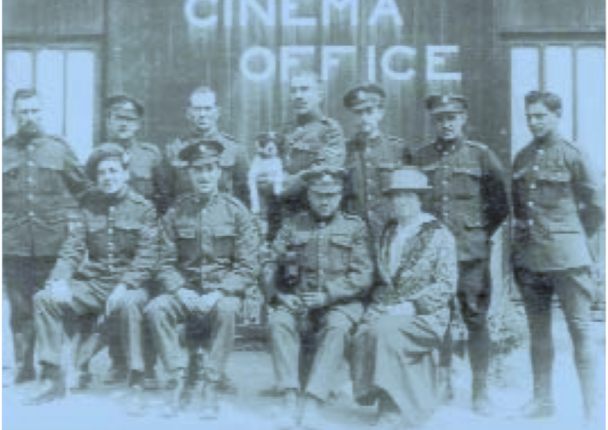
The photograph shows Iso Rae with a group of soldiers at the Cinema Office, Etaples (as reproduced in Betty Snowden's article in the Australian War Memorial magazine, 1999, p.37 Iso Rae with soldiers at Etaples - © Musée Quentovic d’Étaples. Coll° A. Caron).
Exhibitions
1881-1883
exhibited with the Victorian Academy of Arts
1883
NGV students’ exhibition, the jury made special mention of her work and she received further honours in 1884 and 1886
1887
NGV students' exhibition third prize for her painting Persuasion
1889-90
included in the New Zealand and South Seas Exhibition, Dunedin
1892
exhibited with the Society of Friends of the Arts of Etaples
exhibited Old Salon, Paris and with the Royal Society of British Artists, London.
1898-1907
exhibited with the Society of Oil Painters, London
1908
included in exhibition at Mrs Theo Anderson's Studio in Collins Street, Melbourne
Achievements, Collections & Commissions
COLLECTIONS
Australian War Memorial, Canberra
National Gallery of Australia, Canberra
National Gallery of Victoria, Melbourne
Musee de Touquet, France
Bibliography
A Century of Australian Women Artists 1840s – 1940s, Deutscher Fine Art, 1993
Gorman, Clem and Therese, Interpide, Australian Women Artists in Early Twentieth Century France, Monash University Publishing, 2020
Hammond, Victoria and Peers, Juliet, Completing the Picture: Women Artists and the Heidelberg Era, Artmoves, 1992, p.62
Holford, Josie, Women Artists of WW1: Iso Rae, Blog, 6 January 2018
McDonnell, Bridget, 'A woman’s forgotten war’, in Antiques and Art Australia, Volume 1, Number 5, Spring 1989
Snowden, Betty, Iso Rae in Etaples : Another perspective of war, Wartime : official magazine of the Australian War Memorial, 1999, no. 8, pp36-41
Walton, Alex curator at the Imperial War Museum, BBC Essays on War podcast https://www.bbc.co.uk/sounds/play/m00011hs
https://www.letouquet-musee.com/collections/la-colonie-d-etaples/
http://museumstjohn.org.uk/research/projects/st-john-first-world-war/